4-hole ocarina finger chart
The 4-hole pendant is the simplest ocarina you can buy: four holes on the front, no thumb holes, and one octave from C to the C above. It uses the English fingering system, the same as most 6-hole pendants, so if you move up to a 6-hole later, everything you learned here still works.
4-hole pendant ocarina finger chart (C)
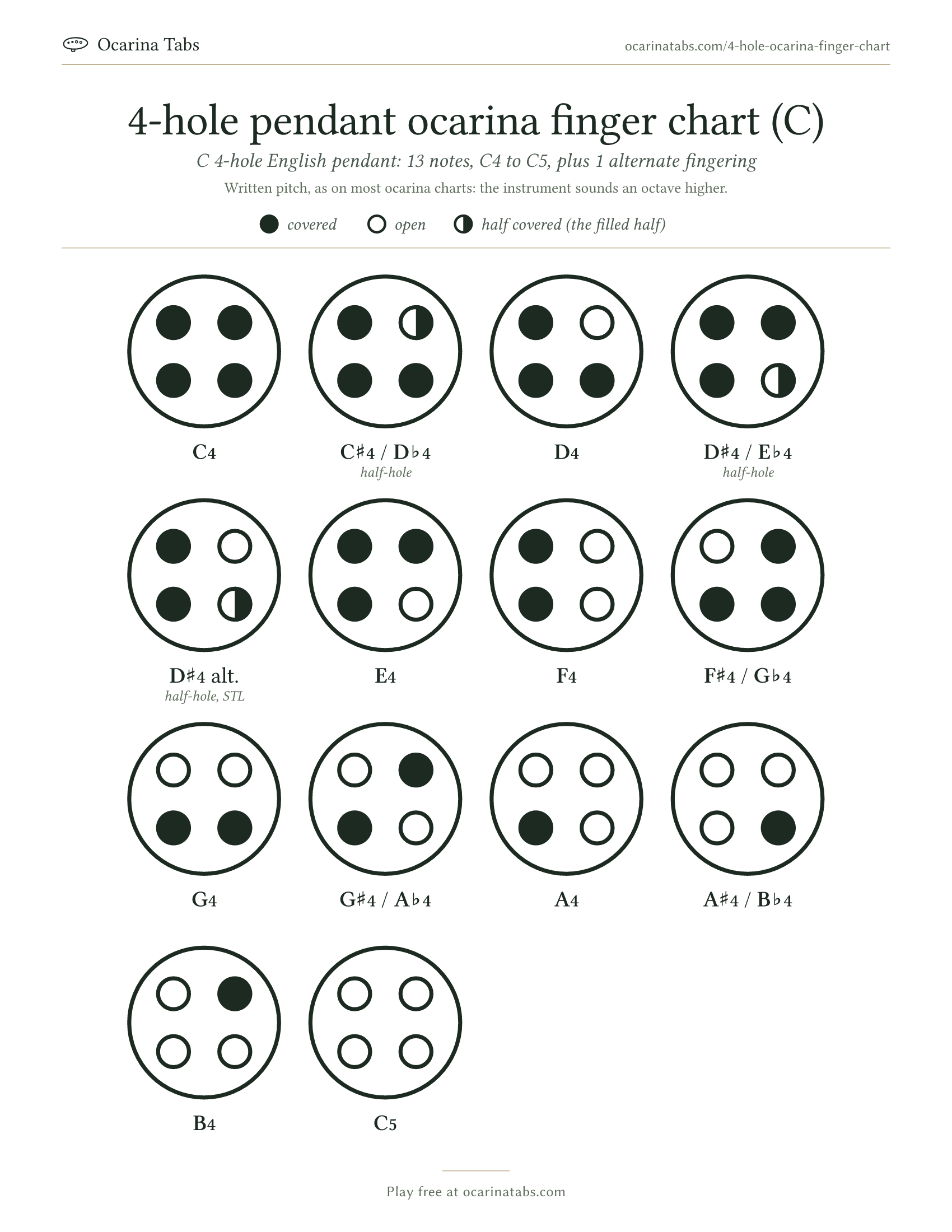
| Note | Fingering |
|---|---|
| C4 | all holes covered |
| C♯4 / D♭4 | all holes covered except right middle half-covered (right half) |
| D4 | all holes covered except right middle |
| D♯4 / E♭4 | all holes covered except right index half-covered (right half) |
| D♯4 / E♭4 (alternate) | all holes covered except right middle and right index half-covered (right half) (half-hole, STL), alternate fingering |
| E4 | all holes covered except right index |
| F4 | all holes covered except right middle and right index |
| F♯4 / G♭4 | all holes covered except left middle |
| G4 | all holes covered except left middle and right middle |
| G♯4 / A♭4 | all holes covered except left middle and right index |
| A4 | all holes open except left index |
| A♯4 / B♭4 | all holes open except right index |
| B4 | all holes open except right middle |
| C5 | all holes open |
Why four holes give a whole octave
Four holes can be covered in 16 different ways, and that is how such a small instrument plays a full octave. Eleven of the 13 notes come from combinations of fully covered and fully open holes. Covering all four holes gives the low C; opening all four gives the high C.
The two half-holes
The other two notes, C sharp and D sharp, need one hole half covered: the right middle finger's hole for C sharp and the right index finger's for D sharp. The chart shows which half to cover, and an alternate D sharp from STL Ocarina's chart.
What fits in one octave
Because the range is a single octave, the 4-hole suits tunes that stay close together, and plenty do, including most nursery songs and many hymns and carols.
Of the 253 tabs in our curated library, 96 fit a 4-hole pendant. The 4-hole song list collects them, moved into range, with 4-hole charts under every note.
Easy songs that fit
- Prelude of Light by Koji Kondo. Easy: 12 notes, G4 to C5, no sharps or flats. Moved 2 semitones down to fit.
- Requiem of Spirit by Koji Kondo. Easy: 12 notes, D4 to A4, no sharps or flats.
- Zelda's Lullaby by Koji Kondo. Easy: 14 notes, F4 to C5, no sharps or flats. Moved 2 semitones down to fit.
- Hot Cross Buns. Easy: 17 notes, G4 to B4, no sharps or flats.
- Mary Had a Little Lamb. Easy: 26 notes, F4 to C5, no sharps or flats. Moved 2 semitones down to fit.
- When the Saints Go Marching In. Easy: 31 notes, C4 to G4, no sharps or flats.