12-hole ocarina finger chart
A 12-hole ocarina covers a little more than an octave and a half: on an Alto C, from the low A to the high F, with every sharp and flat in between. The chart below shows all 21 notes. Switch to Alto F if that is what you have. The fingerings are the same; only the note names move up a fourth.
12-hole ocarina finger chart (Alto C)
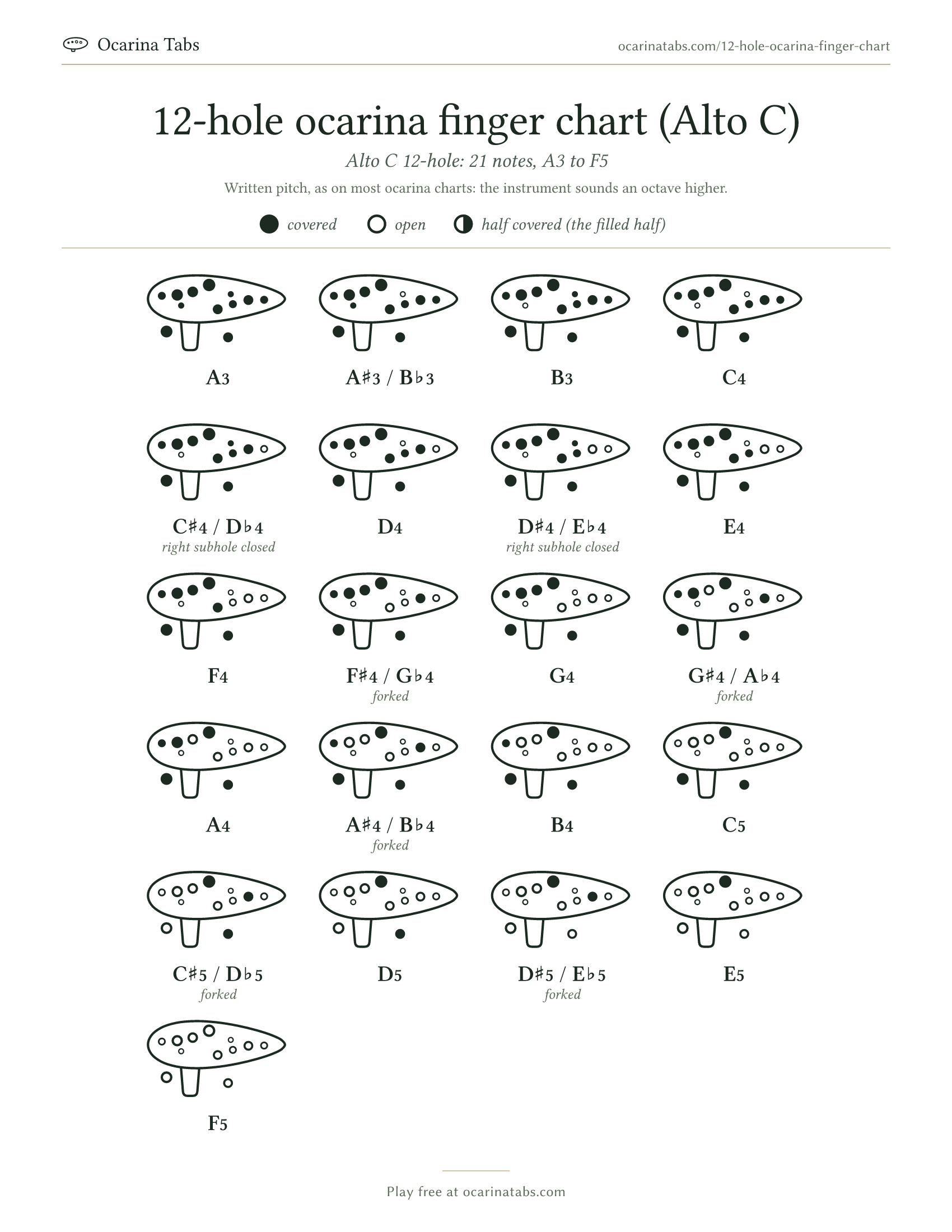
| Note | Fingering |
|---|---|
| A3 | all holes covered |
| A♯3 / B♭3 | all holes covered except right subhole |
| B3 | all holes covered except left subhole |
| C4 | all holes covered except left subhole and right subhole |
| C♯4 / D♭4 | all holes covered except left subhole and right pinky (right subhole closed) |
| D4 | all holes covered except left subhole, right subhole and right pinky |
| D♯4 / E♭4 | all holes covered except left subhole, right ring and right pinky (right subhole closed) |
| E4 | all holes covered except left subhole, right subhole, right ring and right pinky |
| F4 | all holes covered except left subhole, right subhole, right middle, right ring and right pinky |
| F♯4 / G♭4 | all holes covered except left subhole, right index, right subhole, right middle and right pinky (forked) |
| G4 | all holes covered except left subhole, right index, right subhole, right middle, right ring and right pinky |
| G♯4 / A♭4 | all holes covered except left subhole, left ring, right index, right subhole, right middle and right pinky (forked) |
| A4 | all holes open except left index, left thumb, left middle, left pinky and right thumb |
| A♯4 / B♭4 | all holes open except left index, left thumb, left pinky, right thumb and right ring (forked) |
| B4 | all holes open except left index, left thumb, left pinky and right thumb |
| C5 | all holes open except left thumb, left pinky and right thumb |
| C♯5 / D♭5 | all holes open except left pinky, right thumb and right ring (forked) |
| D5 | all holes open except left pinky and right thumb |
| D♯5 / E♭5 | all holes open except left pinky and right ring (forked) |
| E5 | all holes open except left pinky |
| F5 | all holes open |
12-hole ocarina finger chart (Alto F)
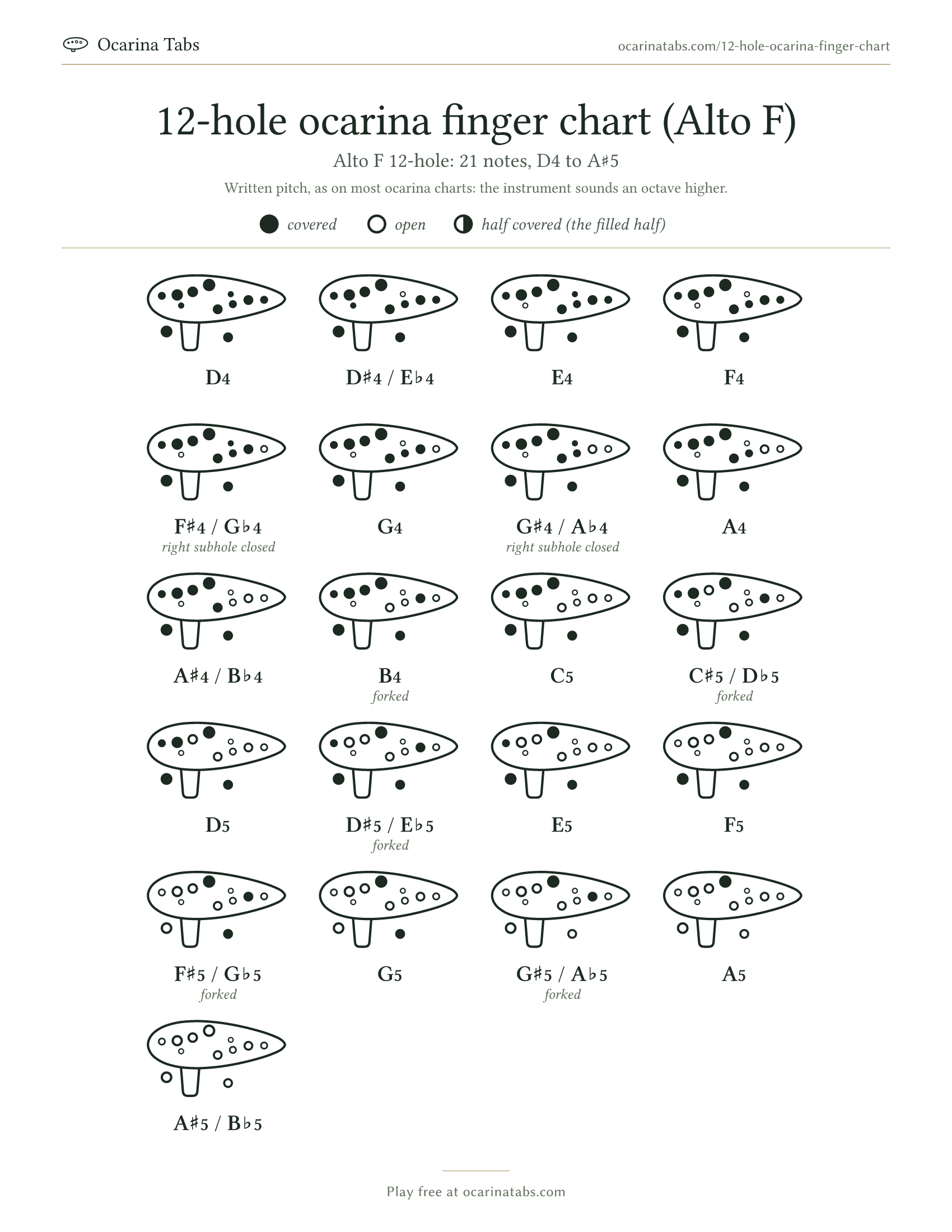
| Note | Fingering |
|---|---|
| D4 | all holes covered |
| D♯4 / E♭4 | all holes covered except right subhole |
| E4 | all holes covered except left subhole |
| F4 | all holes covered except left subhole and right subhole |
| F♯4 / G♭4 | all holes covered except left subhole and right pinky (right subhole closed) |
| G4 | all holes covered except left subhole, right subhole and right pinky |
| G♯4 / A♭4 | all holes covered except left subhole, right ring and right pinky (right subhole closed) |
| A4 | all holes covered except left subhole, right subhole, right ring and right pinky |
| A♯4 / B♭4 | all holes covered except left subhole, right subhole, right middle, right ring and right pinky |
| B4 | all holes covered except left subhole, right index, right subhole, right middle and right pinky (forked) |
| C5 | all holes covered except left subhole, right index, right subhole, right middle, right ring and right pinky |
| C♯5 / D♭5 | all holes covered except left subhole, left ring, right index, right subhole, right middle and right pinky (forked) |
| D5 | all holes open except left index, left thumb, left middle, left pinky and right thumb |
| D♯5 / E♭5 | all holes open except left index, left thumb, left pinky, right thumb and right ring (forked) |
| E5 | all holes open except left index, left thumb, left pinky and right thumb |
| F5 | all holes open except left thumb, left pinky and right thumb |
| F♯5 / G♭5 | all holes open except left pinky, right thumb and right ring (forked) |
| G5 | all holes open except left pinky and right thumb |
| G♯5 / A♭5 | all holes open except left pinky and right ring (forked) |
| A5 | all holes open except left pinky |
| A♯5 / B♭5 | all holes open |
The natural scale
The natural scale is easy to remember once you see the pattern. Cover all ten main holes, eight for your fingers and two for your thumbs, and leave the two small subholes open: that is the low C. Then lift one finger at a time, starting with the right pinky. The right pinky gives D, the right ring E, the right middle F and the right index G. Then move to the left hand: left ring for A, left middle for B, left index for C. Your left pinky stays down until the very top note.
High notes and the thumbs
The highest notes come from the thumbs. Lift the left thumb for D, both thumbs for E, and lift everything, the left pinky too, for the top F. They need more breath than the middle notes, and the lowest notes need less.
Low notes and the subholes
Below the low C, the subholes give you more notes. With every main hole covered, cover the right subhole for B, the left subhole for A sharp, and both subholes for the bottom A.
Sharps and flats
Most sharps and flats use forked fingerings, where a hole stays covered below an open one: F sharp, G sharp and A sharp in the middle of the range, and C sharp and D sharp at the top. The low C sharp and D sharp close the right subhole instead. The chart marks each of them.
Written pitch and sounding pitch
Ocarina charts are usually written an octave below the sound. This one follows STL Ocarina's charts, so an Alto C reads A3 to F5 here and sounds A4 to F6.
Alto F
An Alto F 12-hole uses exactly the same fingerings. Every note name moves up a fourth, so its chart runs from D4 to B flat 5, and the fingering that gives C on an Alto C gives F on an Alto F. Any tab on this site can be switched to F, and its charts are redrawn to match.
Practise the middle of the range
Easy tunes that stay between the low C and the C above it, so you need no thumb holes and no subholes.
- Requiem of Spirit by Koji Kondo. Easy: 12 notes, D4 to A4, no sharps or flats.
- Hot Cross Buns. Easy: 17 notes, G4 to B4, no sharps or flats.
- When the Saints Go Marching In. Easy: 31 notes, C4 to G4, no sharps or flats.
- Kokiri Forest by Koji Kondo. Easy: 17 notes, C4 to C5, no sharps or flats.
- Game of Thrones Main Theme by Ramin Djawadi. Easy: 18 notes, C4 to A4, no sharps or flats.
- Song of Time by Koji Kondo. Easy: 23 notes, C4 to C5, no sharps or flats.