Double ocarina finger chart
A double ocarina is two ocarinas sharing one body, each with its own windway. This chart is for the common Asian-system double in Alto C, the layout STL uses and most Taiwanese makers follow. Between its two chambers it covers a little over two octaves, from the low A to the C more than two octaves above. That is a fifth higher than a 12-hole can reach.
Double ocarina finger chart (Alto C)
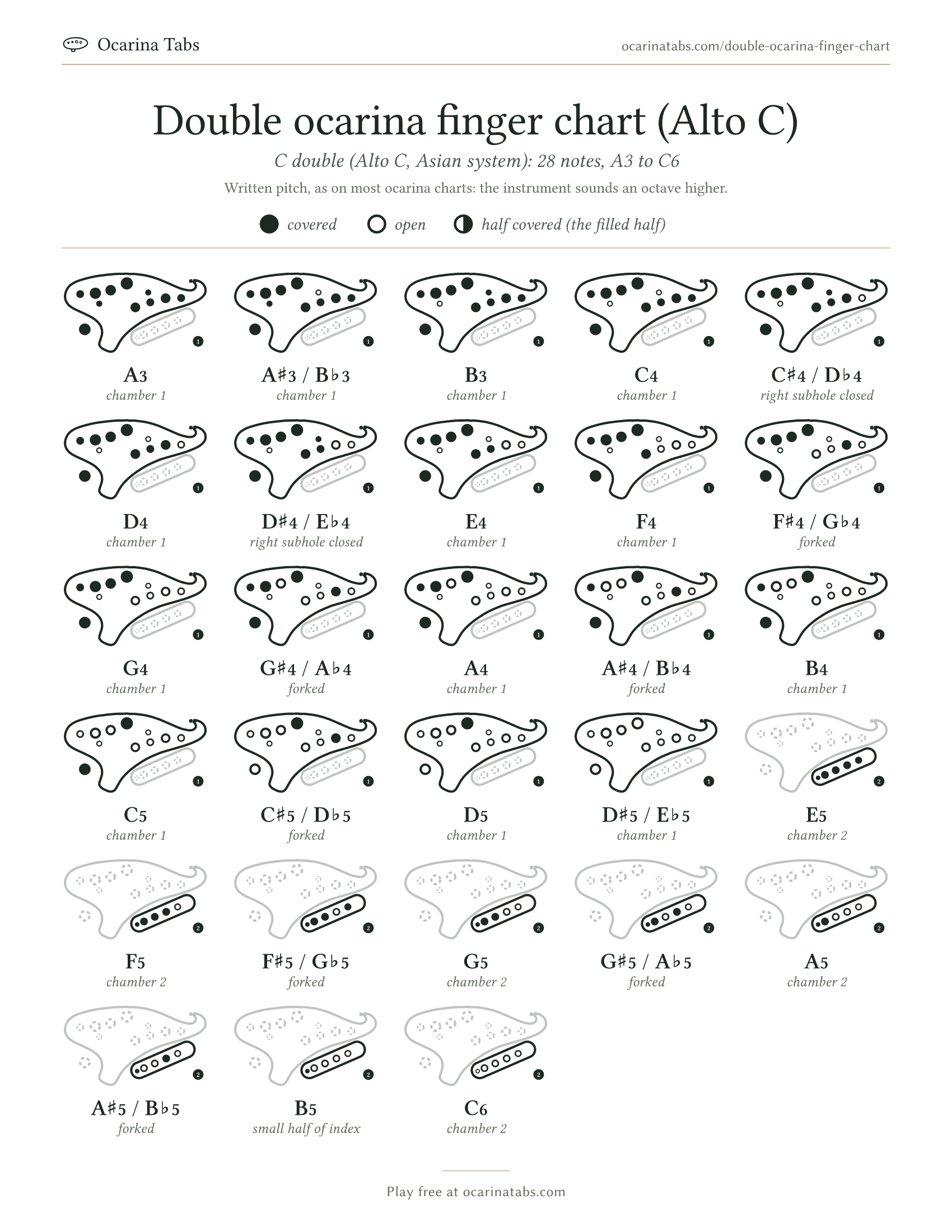
| Note | Fingering |
|---|---|
| A3 | chamber 1, all holes covered |
| A♯3 / B♭3 | chamber 1, all holes covered except right subhole |
| B3 | chamber 1, all holes covered except left subhole |
| C4 | chamber 1, all holes covered except left subhole and right subhole |
| C♯4 / D♭4 | chamber 1, all holes covered except left subhole and right pinky (right subhole closed) |
| D4 | chamber 1, all holes covered except left subhole, right subhole and right pinky |
| D♯4 / E♭4 | chamber 1, all holes covered except left subhole, right ring and right pinky (right subhole closed) |
| E4 | chamber 1, all holes covered except left subhole, right subhole, right ring and right pinky |
| F4 | chamber 1, all holes covered except left subhole, right subhole, right middle, right ring and right pinky |
| F♯4 / G♭4 | chamber 1, all holes covered except left subhole, right index, right subhole, right middle and right pinky (forked) |
| G4 | chamber 1, all holes open except left index, left thumb, left middle, left ring and left pinky |
| G♯4 / A♭4 | chamber 1, all holes open except left index, left thumb, left middle, left pinky and right ring (forked) |
| A4 | chamber 1, all holes open except left index, left thumb, left middle and left pinky |
| A♯4 / B♭4 | chamber 1, all holes open except left index, left thumb, left pinky and right ring (forked) |
| B4 | chamber 1, all holes open except left index, left thumb and left pinky |
| C5 | chamber 1, all holes open except left thumb and left pinky |
| C♯5 / D♭5 | chamber 1, all holes open except left pinky and right ring (forked) |
| D5 | chamber 1, all holes open except left pinky |
| D♯5 / E♭5 | chamber 1, all holes open |
| E5 | chamber 2, all holes covered |
| F5 | chamber 2, all holes covered except chamber 2 right pinky |
| F♯5 / G♭5 | chamber 2, all holes covered except chamber 2 right ring (forked) |
| G5 | chamber 2, all holes covered except chamber 2 right ring and chamber 2 right pinky |
| G♯5 / A♭5 | chamber 2, all holes covered except chamber 2 right middle and chamber 2 right pinky (forked) |
| A5 | chamber 2, all holes open except chamber 2 right index (large half) and chamber 2 right index (small half) |
| A♯5 / B♭5 | chamber 2, all holes open except chamber 2 right index (small half) and chamber 2 right ring (forked) |
| B5 | chamber 2, all holes open except chamber 2 right index (small half) (small half of index) |
| C6 | chamber 2, all holes open |
Chamber 1
Chamber 1 is played almost exactly like a 12-hole ocarina without the right thumb hole. The low notes, the subholes and the natural scale are the same, so if you already play a 12-hole you know most of it. It runs from the low A up to D sharp, which is played with every chamber 1 hole open.
Chamber 2
Chamber 2 takes over at E. Its holes sit in their own row under your right hand, and you move your lips to its windway, which sits next to the first. It works like the right hand of a 12-hole: cover all five holes for E, then open them from the pinky upward to climb to the top C. For the B, open the large half of the split index hole and keep the small half covered.
Changing chambers
The hardest part is the change between chambers, because you move your lips and your right hand at the same moment. Practise slow D to E and E to D slurs until the switch is clean.
Tabs that use the extra range
These tabs go above a 12-hole's top F as written. A C double plays them at that pitch; on a C 12-hole they have to move down.
- Great Fairy Fountain by Koji Kondo. Intermediate: 32 notes, G#4 to G5, 5 sharps or flats.
- New Wave Bossa Nova by Koji Kondo. Intermediate: 31 notes, D4 to G5, no sharps or flats, 2 big leaps.
- Ave Maria (Schubert) by Franz Schubert. Challenging: 95 notes, G4 to G5, 7 sharps or flats, 1 big leap.
- Air on the G String (Air from Suite No. 3) by Johann Sebastian Bach. Challenging: 43 notes, G4 to A5, 3 sharps or flats, 1 big leap.
- Gusty Garden Galaxy by Mahito Yokota. Challenging: 55 notes, E4 to A5, 4 sharps or flats, 1 big leap.
- Pokémon Main Theme (Red and Blue) by Junichi Masuda. Challenging: 49 notes, D4 to A5, 11 sharps or flats.
- The Pink Panther Theme by Henry Mancini. Challenging: 72 notes, G4 to A5, 13 sharps or flats, 2 big leaps.
- Hedwig's Theme by John Williams. Challenging: 60 notes, D#4 to G5, 10 sharps or flats, 2 big leaps.
- The Legend of Zelda Main Theme (Overworld) by Koji Kondo. Challenging: 88 notes, D4 to Bb5, 18 sharps or flats, 1 big leap.
- Super Mario Bros. Underwater Theme by Koji Kondo. Challenging: 57 notes, D4 to A5, 6 sharps or flats, 6 big leaps.
- Speak Softly Love (The Godfather Love Theme) by Nino Rota. Challenging: 60 notes, D#4 to G5, 12 sharps or flats, 4 big leaps.
- The Imperial March (Darth Vader's Theme) by John Williams. Challenging: 66 notes, F4 to A5, 15 sharps or flats, 7 big leaps.
- Maple Leaf Rag by Scott Joplin. Challenging: 89 notes, D4 to A#5, 13 sharps or flats, 17 big leaps.